
Are Arizona Booking Photos Public?
Sometimes. It depends on who holds the record and why. Arizona's public-records law generally lets people inspect existing records held by public officers during office hours. That right has limits, though. Nothing in the statute forces a sheriff to post booking photographs online or to build a statewide photo search. Records made confidential by other laws stay closed. Agencies can also weigh privacy and the public interest before deciding whether release would cause harm.
A booking photo is taken during arrest processing. It shows an identification image tied to an event, nothing more. Custody status shifts quickly after the camera clicks. Someone listed in a jail system today may be released, transferred, or moved into another court process by the time a search runs. For the recorded case outcome, the court disposition remains the better source.
Arizona Public Records Have Limits
A.R.S. §39-121 opens existing public records for inspection, while §39-121.01 requires public bodies to keep records that document their work. Neither rule requires an agency to build an online database or create a new report.
Disclosure can still be limited by another law, a court order, an investigation, safety needs, victim privacy, juvenile rules or the public-records balancing test. Section 39-121.03 covers certain commercial-purpose requests for copies and photographs; an agency may require a statement of purpose and applicable charges. Identify the office, event date, record type and known case or booking number. If the agency withholds material, ask it to name the legal basis.
| Record question | Best source | What it can answer |
|---|---|---|
| Who is in custody now? | County sheriff or jail | Current custody status and, where policy allows, a booking image |
| What happened in the case? | Court clerk or official case record | Charges filed, hearings and case disposition |
| Was there a state-prison term? | ADCRR offender search | State correctional profile and a photo when one is published |
Each source answers a different question. A county roster is not a court judgment. A state-prison profile is not current county custody, either. Arizona's Public Access Case Lookup is a weekly index rather than the official file, eAccess carries date limits, fees, and exclusions, and neither portal supplies a booking photo. Confirm case outcomes with the court and custody or photo policy with the agency.
What Arizona’s Mugshot Law Covers
A.R.S. §§44-7901 and 44-7902 target one commercial practice, not publishing in general. Section 44-7901 defines a booking photograph. It means a photo taken in connection with an arrest or some other brush with the criminal justice system. A "criminal justice record" bundles the photo with the person's name, address, physical description, and charges. The statute also defines a "mugshot website operator," meaning someone who posts those records on a publicly accessible internet site for a commercial purpose.
The text of A.R.S. §44-7902 then draws the line. A covered operator cannot use a criminal justice record or its identifying details to solicit business for pecuniary gain, a phrase that simply means financial benefit. Demanding payment to remove or revise the record counts expressly.
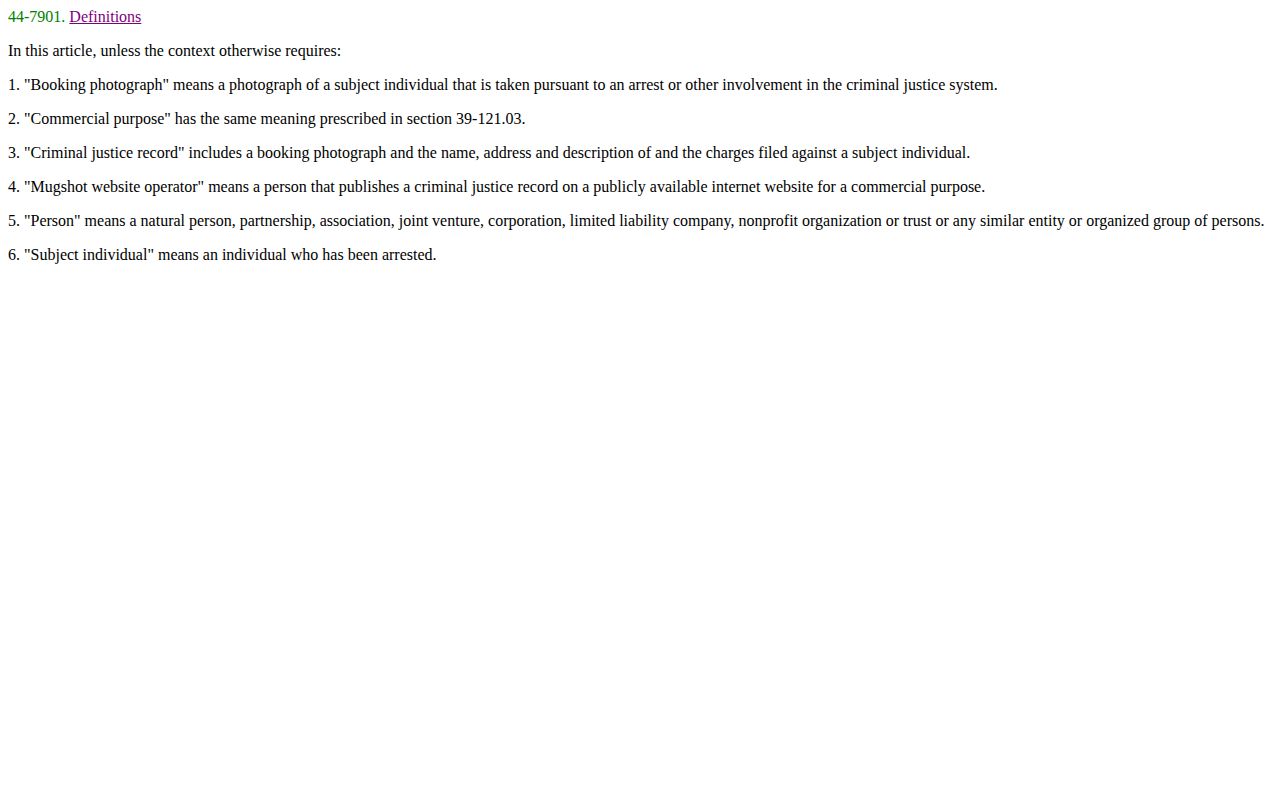
The law also hands enforcement to individuals. A person harmed by a violation can bring a private civil action. Damages start at $100 per day for the first 30 days, rise to $200 per day for the next 30, then reach $500 per day after that. No outcome is guaranteed. What matters is how a covered operator uses a record to drum up business, not simply that a photo sits online.
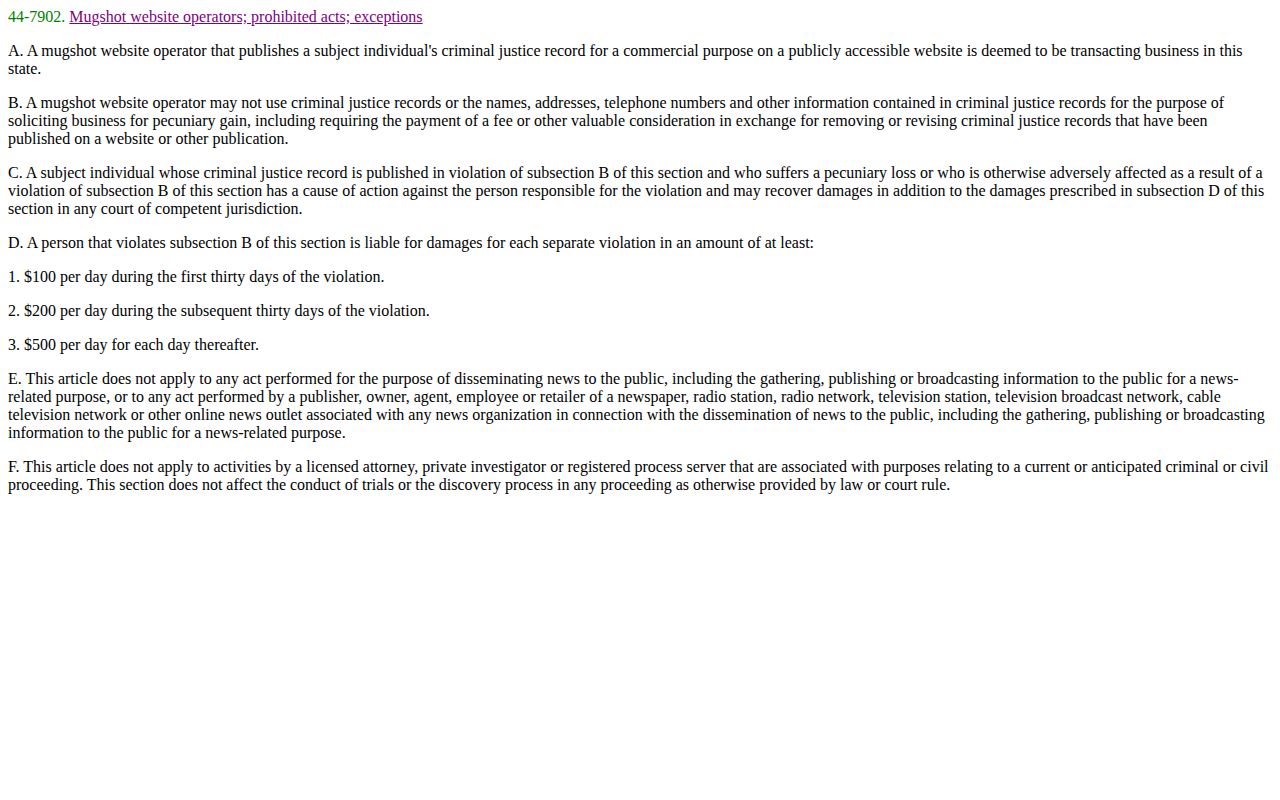
The exceptions deserve attention. The statute does not sweep every public record or news report into the same rule.
Why Arizona’s 2019 Rule Is Narrow
Arizona passed its commercial mugshot rules through HB 2191. The measure is Chapter 42 of the Fifty-Fourth Legislature's First Regular Session. The effective date was August 27, 2019. It targets commercial use of criminal justice records. That includes paid removal or revision schemes. The official HB 2191 summary and engrossed bill trace the measure's history.
Section 44-7902 carves out several users. News dissemination is exempt. So are newspapers, radio, television and online news outlets. Attorney, investigator, and process-server work tied to a current or expected case also qualifies. That does not put a news story on the same legal footing as a covered commercial operator. Nor do the exceptions turn news coverage into a full jail roster or grant a general right to erase every arrest record.
What Houston Actually Decided
Houston v. County of Maricopa is No. 23-15524. The Ninth Circuit reviewed it after an early dismissal. Nothing went to trial there. The panel asked whether the claims, taken as pleaded, were enough to survive at the pleading stage. The plaintiff's account was straightforward. She said Maricopa posted booking photos with identifiers, third-party sites copied them, and some copies lingered after the county pulled its own down. On that account, the court found a plausible substantive due-process claim about punishment before trial. It reversed dismissal of that claim. Procedural due process and speedy-trial claims stayed dismissed, and the Ninth Circuit opinion sets out the full reasoning.
Why Arizona Photos Vary by County
Every Arizona county handles booking photos its own way. Maricopa's MCSO has run a current-custody search plus a separate photo-capable page that accepts a booking number or a name and date of birth. Check the live interface, though. Policy can change without much notice.
Cochise County shut down its inmate list and mugshot page on September 9, 2024, after a legal review. One day later, Pima County said it would stop releasing booking photos "in any format" and removed its booking tab. Apache, Navajo, Mohave and Yavapai post custody data without routine public photos. La Paz does not release civilian mugshots. Other counties rely on documents, phone calls, or formal requests. None of this proves a photo never existed.
The Arizona County Directory reaches each sheriff and jail. When no image shows, ask the agency directly whether it holds the booking record and whether access is limited. An aggregator copy is never the official answer.
Juvenile and Withheld Records
A.R.S. §8-208 sets the rules for juvenile openness. Delinquent referrals, arrest records after a youth is accused as an adult under §13-501, and some delinquency or disposition hearings may be open under its terms. Victim identity stays protected. Adoption, severance and dependency matters remain closed, and a juvenile court can order confidentiality whenever the public interest calls for it. Ordinary case lookup skips juvenile incorrigible and delinquency cases.
A name in a county system proves neither adulthood nor an open case. Agencies can redact or withhold details that identify victims, informants, protected witnesses or minors. Medical facts, sensitive methods, sealed records and material protected by law or court order can go too. The reason for a withhold rests with the holding agency or court. An aggregator cannot answer that question.
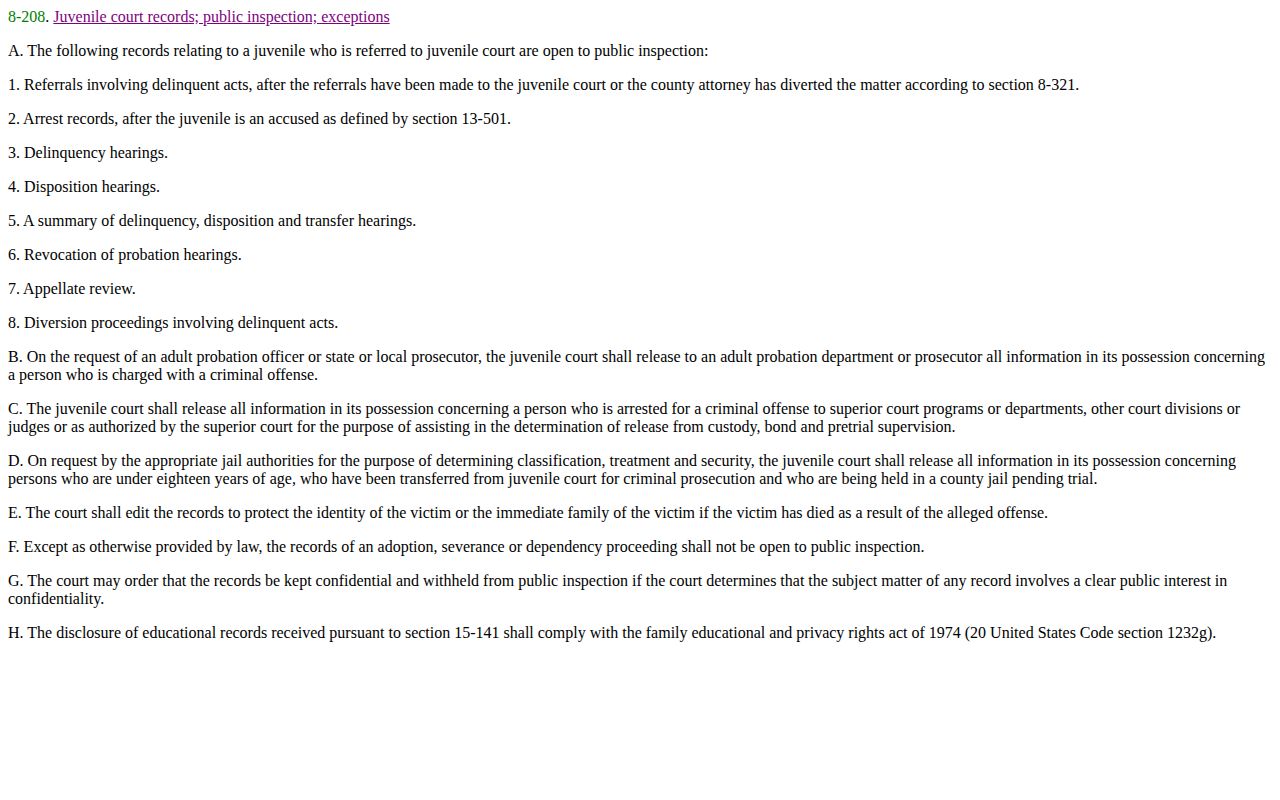
The categories decide. Check the actual court and agency rule before calling any youth record public.
Where Arizona Records Can Be Checked
Match each question to its official source. County jails track current custody, while the sheriff or police may hold the booking record. Courts show case outcomes. The Arizona Department of Corrections, Rehabilitation & Reentry (ADCRR) keeps state correctional profiles, and a prison photo is not a county booking photo.
- Check the county source. Search the sheriff or jail for current custody. A missing entry may mean release, transfer or a different booking agency.
- Ask the agency. Request an existing booking sheet, arrest report or photo by name, date and known number. Ask what is withheld and why.
- Confirm the case result. Use the court clerk’s record. Public Access Case Lookup is a weekly index; eAccess has limits and fees.
- Check state-prison records separately. ADCRR’s Inmate Data Search may show a photo and active, inactive, supervised or absconder-related status.
A request never guarantees a photo. The agency may lack the image, may have disposed of it under a schedule, or may need to withhold part of the record.
Sealing an Arizona Case Record
A.R.S. §13-911 opens three paths to sealing. One is a conviction once sentence terms and money obligations are complete. A dismissal or not-guilty result is another. An arrest with no charges is the third.
File in the conviction court, or the court that heard the dismissed or acquitted complaint. With no charges filed, use the initial-appearance court. If there was no initial appearance, the arrest county's Superior Court takes the petition.
Waiting periods vary by offense class. After a nonmonetary sentence or probation, a class 2 or 3 felony carries a ten-year wait. Class 4 through 6 felonies wait five years, a class 1 misdemeanor three, and class 2 or 3 misdemeanies two. A qualifying §13-909 vacated offense or petty offense may qualify at once. Fines, fees and restitution must be addressed first. A later felony adds five years, and denial generally bars refiling for three. Dangerous, serious, violent and aggravated felonies are excluded. So are specified weapon, injury, trafficking and chapter 14 or 35.1 offenses.
The court lets the prosecutor and requesting victims respond. It then weighs the petitioner's interests against public safety. Arizona Courts posts forms AOCCRSL1F, AOCCRSL2F and AOCCRSL1I on its sealing page. Previously published material may remain accessible, it warns.
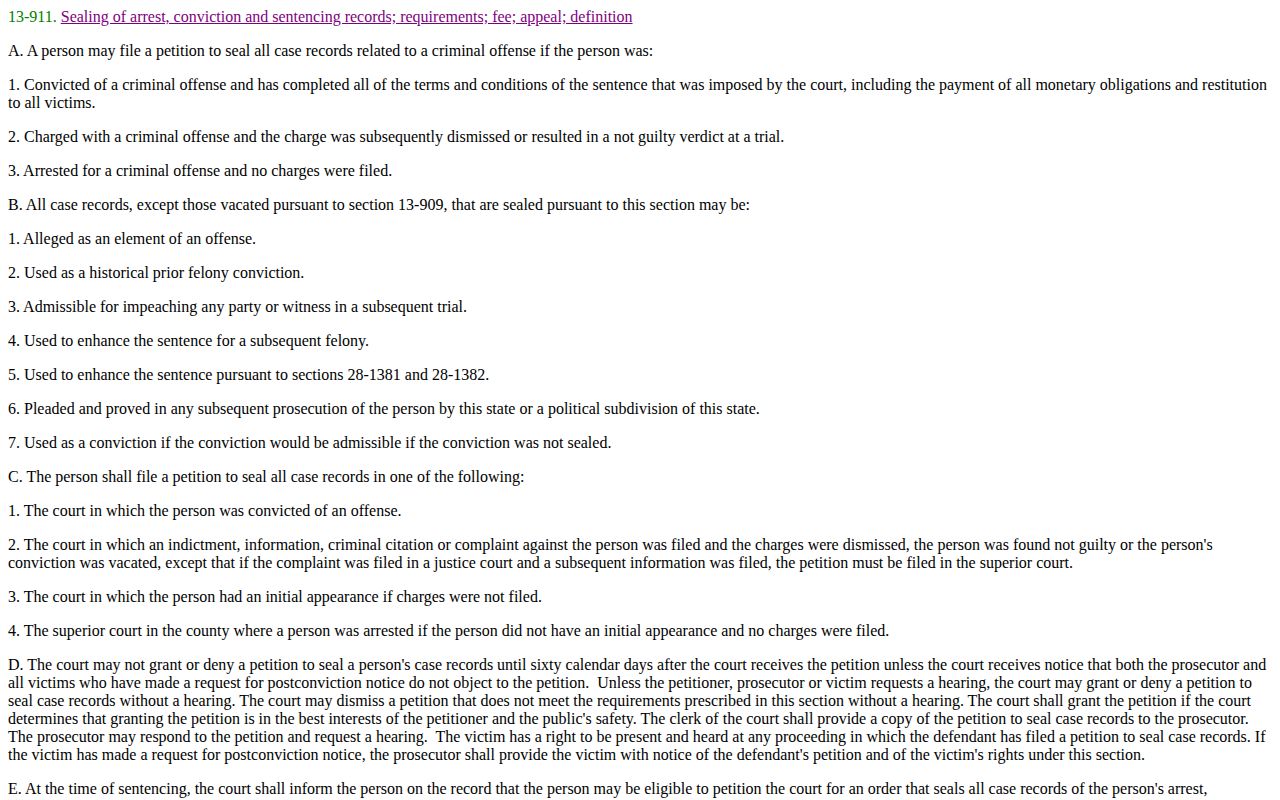
The form route and the statutory eligibility rules should be checked together before filing.
Set-Aside Is Not Expungement
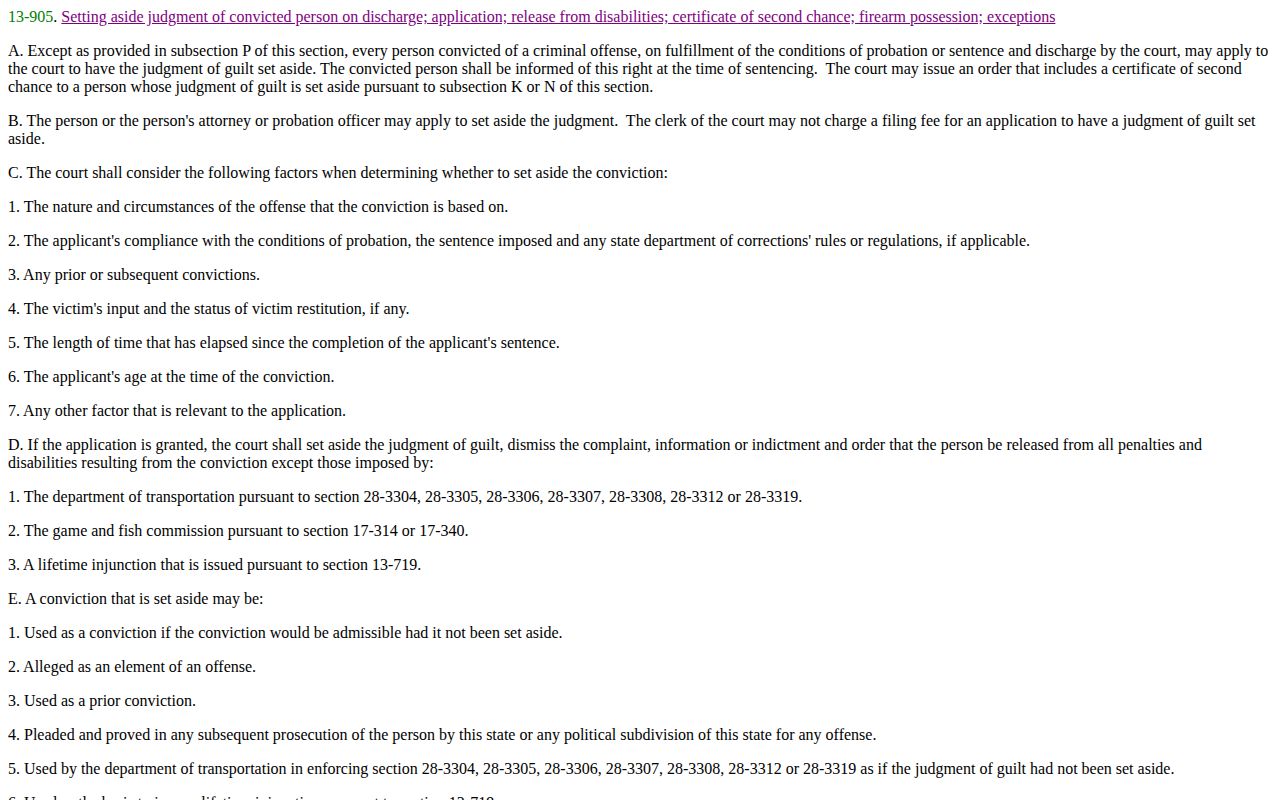
A set-aside under A.R.S. §13-905 can be requested after probation or sentence and discharge, subject to exclusions. The court weighs the offense, compliance, prior record, victim input, restitution, time passed and age. A grant sets aside the judgment. It generally dismisses the complaint and releases related penalties or disabilities, with statutory exceptions.
Nothing gets erased. DPS annotates the record. Law enforcement keeps its own copy. A set-aside may support an update request, but it cannot prove every photo or old page has vanished. Read the Legislature's §13-905 text for the details.
A.R.S. §36-2862 is a narrow Proposition 207 remedy. It covers specified marijuana conduct that predated the law. That means possession or transport of up to two and one-half ounces, up to six plants at a primary residence, and qualifying paraphernalia. The prosecutor gets 30 days to respond and may offer clear and convincing evidence of ineligibility.
A grant vacates the covered judgment and expunges it. Arresting and prosecuting agencies generally cannot release it as a public record, except to the person or their attorney. Not every offense or photo is covered. The statute and Arizona Courts forms spell out the details.
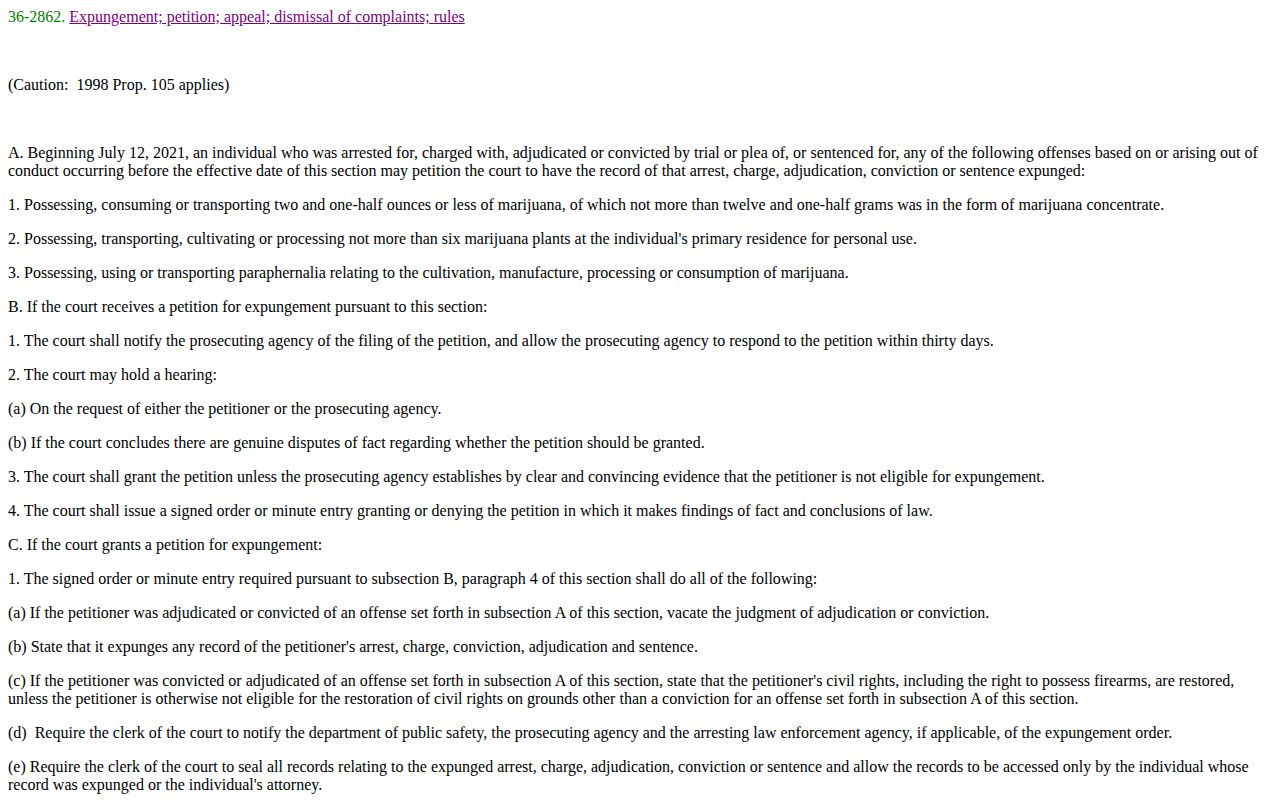
An order under this section covers only the conduct it names. It is not a wipe of unrelated booking records.
| Remedy | What it changes | What it does not promise |
|---|---|---|
| §13-911 sealing | Eligible court and related records are sealed after a petition and court order | That a photo already copied by a publisher or search index vanishes |
| §13-905 set-aside | The court sets aside a qualifying judgment and DPS annotates the record | Deletion of the law-enforcement copy |
| §36-2862 expungement | Expunges specified qualifying pre-Prop 207 marijuana conduct by court order | A general remedy for unrelated arrests or offenses |
Copied Photos and Free Opt-Outs
Start with the source. Ask the agency that made the record, or the original publisher, to correct it. Then work through every site hosting its own copy. For each one, send the exact page URL plus the paperwork that backs your request. Court papers should go out only when a publisher truly needs them.
Some publishers make removal painless and free. RecentlyBooked accepts claims for dismissed, sealed or expunged cases. It also takes wrong-person matches, duplicates, juvenile matters and stale entries. Its form wants the exact URL, full name, arrest date, state, county and a stated reason. Supporting papers go to info@recentlybooked.com. Accurate entries tied to current public sources generally stay up, per its policy. Mugshots.com likewise charges nothing. It may require signed court papers and its own record ID. Its described process runs up to ten business days, with no hard deadline attached.
Neither policy controls other publishers or wipes out copies stored elsewhere. Plenty of aggregators and newsrooms never post a free opt-out at all. A contact form alone promises nothing. Skip anyone demanding money for guaranteed deletion. Google's outdated-content tool can refresh a search result once the underlying source changes. But it leaves the source page, other caches and independent copies untouched.