
Arizona ADCRR Mugshots
ADCRR stands for the Arizona Department of Corrections, Rehabilitation & Reentry. The agency runs the state prison system, and its Inmate Data Search is the official lookup for people held there. The tool covers state custody only. It is not a statewide arrest list. It won't replace a sheriff's booking roster either. Someone arrested by local police usually waits in a county jail while the case moves. State custody starts only after a sentence and transfer.
The agency's page links to the ADCRR Inmate Data Search. A profile may carry a correctional photo. It also lists identity and custody fields. But the image's timing matters. Photos can come from an institutional or release setting under department policy. That is not the county booking photo. A result also reflects what the system displayed at the moment you checked.
The ADCRR search instructions carry a plain warning: release dates and release types stay unverified and can change. The page also points readers to the right court clerk for offense details. Take that seriously. Confirm anything time-sensitive with the agency directly. Old printouts go stale. A release date can affect a visit, a safety plan, or another tight deadline, so read the state's search screen and its limits before relying on a single profile.
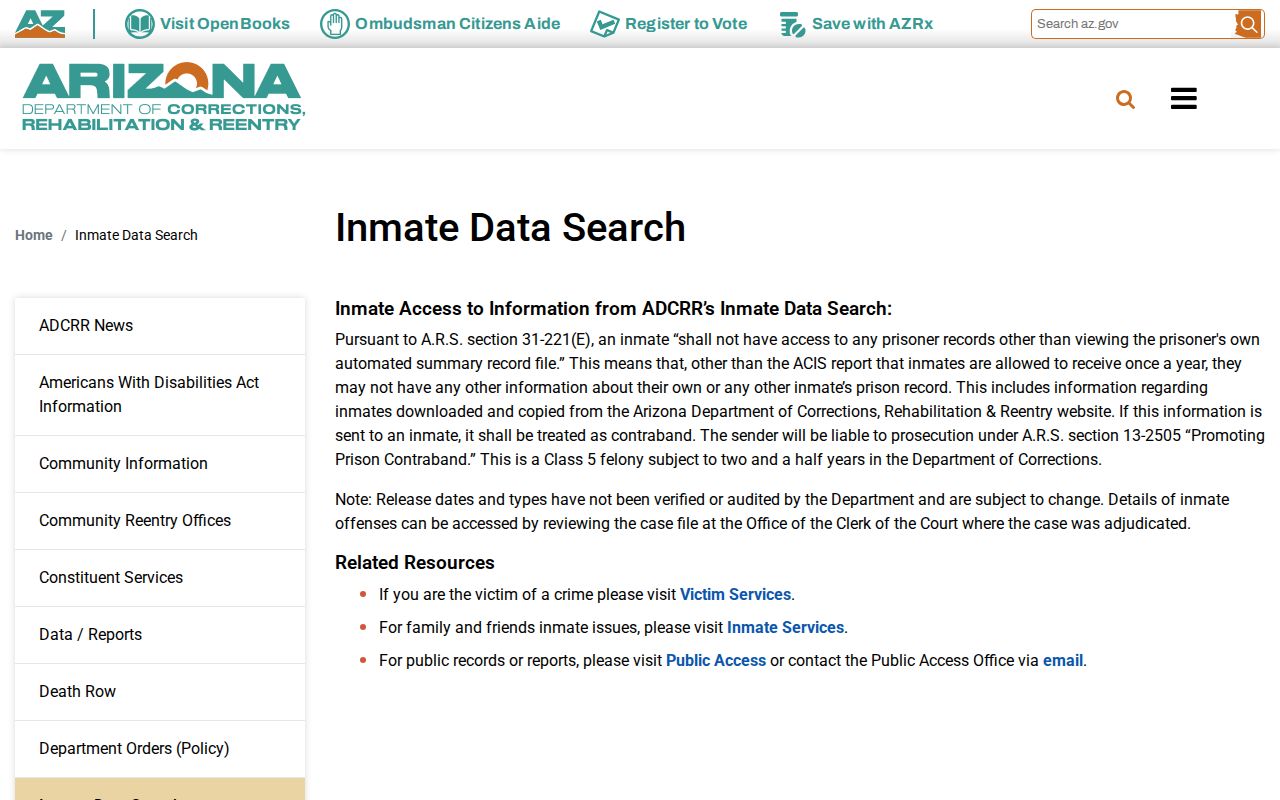
The notice separates correctional data from an audited court record. It also points readers to Public Access for agency records, which matters when you want a copy of a file.
Search ADCRR Mugshots
Begin at the department's inmate-data page or its linked search tool. The search takes a name or an ADCRR/ADC number. A number is the surest path to one profile. Names alone invite mix-ups. When you search by name, study every identifier and status line. Decide the result matches your person only after that. Similar names appear often, so a match on spelling alone proves little.
- Open the official ADCRR Inmate Data Search from the department's own inmate-data page.
- Enter the ADCRR/ADC number if you know it. Otherwise, search the name and review the other identifiers shown with each result.
- Open the matching profile and note its displayed status, location, sentence or release information, and photo, if one appears.
- Write down the date you checked. The department says release dates and release types have not been verified and may change.
- Use the court clerk for the charge, judgment, and disposition. If the public search does not answer a records question, use ADCRR Public Access.
This lookup reaches the state correctional record, not a fresh county arrest entry. That gap matters most when someone has moved between systems, since the path can run from arrest to county booking, release, sentencing, and then transfer into ADCRR. The state profile helps confirm the correctional stage. The county agency keeps the booking record. The court keeps the case file.
Results change as agency records update. Save the details you need, but go back to the live system before acting on a location or release date. A saved image can lag. So can an old search result.
Fields on ADCRR Profiles
Read each result as separate fields, not just a photo. The department describes a result as showing status, location, and sentence or release information. It also lists any photo. The table covers search details named in the agency's instructions. Not every field shows on every profile. Treat the image as one part of the whole.
| Profile detail | How to read it |
|---|---|
| Name or ADCRR/ADC number | Use the number when available. If searching by name, compare the full name and other identifiers on the result. |
| Status | Check whether the profile describes active, inactive, supervised, parole-related, or absconder information. A retained profile does not prove current prison custody. |
| Location | Read the location as the value displayed by ADCRR when checked, then verify it with the agency when current placement matters. |
| Sentence or release information | Dates and release types are unverified and may change, according to ADCRR. They are not a court-certified disposition. |
| Photo | Record whether an image is displayed. A missing image does not prove no institutional photo exists, and a displayed image is not necessarily a county booking photo. |
Read the status field and the photo together. An inactive or supervised marker doesn't mean the person is still in prison. A missing photo proves nothing either. The department may hold images the public result never displays. The interface is not the full agency file.
Note: Save the date checked beside any release information because ADCRR says those values are unverified and may change.
ADCRR Photo Update Rules
State prison photos in Arizona answer to Department Order 901. That policy has nothing to do with county jail rosters. The order sets out institutional photographs. There is a front view and a profile view. Full-length shots are taken for release. ADCRR keeps these images in its Mug Photo Interface. Each one serves an agency purpose inside the correctional system. That image is not a local arrest photo. The same person may still have a county case on file.
The order also builds in a refresh schedule. A new photo is required whenever an incarcerated person's appearance changes in a noticeable way. Beyond that, the department reshoots at least once every five years of incarceration. Release photos run on a tighter clock. They are taken no earlier than 180 days before release. No shot happens later than ten days before it. That timing explains a common puzzle. A profile image may not match how someone looked on the day a visitor checks.
Fresh does not mean public, though. The department takes new photos on schedule. It makes no promise that each one shows up in search results.
Read ADCRR Department Order 901 for the full photo procedure straight from the agency.
Describe any image by its record source and the date it was checked. A search page may display a correctional image. The county jail may hold a separate shot from booking. Court records remain the place to learn how a case was resolved. The agency profile shows what ADCRR displays now.
Former ADCRR Profiles and Status
The public search covers a wide band of statuses. Active profiles appear. So do inactive ones, supervised and parole-related information, and an absconder status. That range matters. An ADCRR result is not a live prison roster. The exact status on the page controls what it means. A profile can stay visible long after active incarceration ends. There is no promise, though. Not every former offender stays searchable forever. The individual result and its dates govern what the search shows on any given day.
Labels like "inactive" and "supervised" describe a record context. An absconder entry likewise reflects a correctional status rather than a county booking event. To confirm a current release or supervision question, check the live profile. When the displayed information is unclear, contact ADCRR directly.
A historic profile still has real value. It can point to where a state record or an older correctional photo is held. It does not open every underlying document to the public. Name the person and the specific item in any request. Let the department say whether that item can be released.
Note: A visible ADCRR profile can outlast active custody, while the public system does not promise permanent access for every former person.
ADCRR Photos vs County Bookings
Two different agencies stand behind these two kinds of photos. A state-prison image comes from ADCRR under Department Order 901. A county booking photo comes from the sheriff or jail that handled the local arrest. It follows that county's own publication and retention practices. Arizona counties share no uniform photo policy. So a missing county image changes nothing there. It does not make the ADCRR photo a stand-in or a duplicate.
| Record source | What it describes | Photo meaning |
|---|---|---|
| County sheriff or jail | Local booking and detention records after an arrest in that county. | A booking image, if that county releases one through its own roster or records process. |
| ADCRR | State correctional profiles, including people serving state sentences and some inactive or supervised records. | An institutional or release image made under Department Order 901, if shown in the public profile. |
| Court clerk | Charges, case events, judgments, and dispositions in the relevant court file. | The court record may reference evidence or exhibits, but it is not a county jail roster. |
Start with the record you actually need. For a local booking, start with the county. It made the arrest or holds the jail record. The Arizona County Directory routes each county's system to its local starting point. Photo rules differ from one to the next. For a state sentence or a correctional profile, use ADCRR. For a case outcome, follow the department's direction to the court clerk involved.
These steps can overlap. One result still cannot stand in for all three records. A county booking date may precede a state sentence by months or even years. A current correctional profile may lack the full local booking sheet. A court docket may not display the jail's booking photo. Ask the agency that created each record for that record.
Request ADCRR Photos and Records
ADCRR's subpoenas and public-records page offers online request options for three record types. Choose a Basic Agency Record, an Employee Record, or an Inmate Record. A Public Access contact number is listed there too. A strong request names the person. Give the ADCRR number if known, and identify the institution when possible. State the record type and an approximate date. For a photo, specify the item: an institutional image, a release photo, or something else.
The published fee schedule splits costs by format. Paper copies carry one price, digital copies another. Storage media and digital audio or video are priced separately. Check the live agency page before sending payment or requesting a different format.
| Request item | Published fee |
|---|---|
| Hard-copy page | $0.50 per page |
| Digital page | $0.10 per page |
| Disc or drive | $15 per disc or drive |
| Digital audio or video | $5 per five minutes, capped at $15 |
ADCRR handles photo and record requests through official channels. Its subpoena and public-records page spells out the online request routes, and Public Access takes calls at 602-542-5886. No fixed turnaround is promised. Even a complete request can face review, and the agency may withhold or redact material under another law, a court order, an institutional-safety rule, or a privacy and public-interest balance. Ask for an existing record, clearly described. The department will not build a statewide mugshot list. If a search profile would serve, note its date and use the live page. Questions about a charge or a sentence belong with the court clerk, not with an ADCRR records request.
Note: The posted fee schedule covers listed copy formats, but the agency does not give a fixed completion date for requests.
ADCRR Search and Prisoner Records
A warning tied to A.R.S. §31-221(E) appears on the ADCRR search page. Prisoners may not hold another prisoner's records. A limited automated summary record is the one exception the department describes. The agency also cautions that copied or downloaded prison records, once carried into a correctional setting, can become contraband or trigger other legal problems. That restriction works inside custody. It is not permission to mail a record to an inmate. Keep any inquiry about a person in custody between yourself and the agency or the court. Never forward public search results into a prison. Public does not mean distributable everywhere. ADCRR's own page carries the current warning. It also lists the public request routes. A public profile has a narrow purpose. It is an agency summary for the public. Treat it as such, not as a license to share other prisoners' records or to send any downloadable file to any recipient.
Arizona Offender Search Boundaries
Missing from ADCRR does not mean no arrest happened. The case may still sit in a county jail. It may have ended without a state-prison sentence, or it may belong to a different custody system entirely. All a blank result shows is that the corrections search returned no matching profile under the name or number entered. Double-check both before concluding anything. A known federal sentence calls for the Federal Bureau of Prisons locator, a separate custody search. That locator offers no booking-photo archive. Local arrests belong to the arresting county or jail. Charges, hearings, and a final judgment belong with the court clerk named in the case. Each source answers a different question. Use the one that fits. ADCRR works best when the question is state correctional custody and the department's displayed photo or profile. Do not stretch it into a complete Arizona arrest search. A county booking file, a state-prison profile, and a court disposition are distinct records, held for distinct purposes.