
Arizona Fugitive Lists and Roles
Arizona publishes no single statewide most-wanted photo list that is public, complete, and current. What exists instead are agency pages with different jobs. The Arizona Department of Public Safety (DPS) WANTED Task Force teams with federal, state, and local partners on active warrants. The Arizona Department of Corrections, Rehabilitation & Reentry (ADCRR) lists "Absconder" as a supervision status. The U.S. Marshals Service (USMS) posts profiles of selected federal fugitives. These cannot be merged into one roster without blurring why each person is listed. Go to the agency that keeps the record you need.
Some fugitive pages show a person's image. No wanted photo feeds a statewide gallery, though. Photos age, and name matches can be wrong. Verify any entry with the issuing court or agency. If you want to know who sits in county custody right now, use the booking routes on the Arizona arrest and booking record hub; a warrant result will not answer that.
| Official source | What it covers | Key limit |
|---|---|---|
| Arizona DPS Warrant Search | Court-reported warrant information | Not real-time, current, or complete; the court must confirm active status |
| DPS WANTED Task Force | Joint fugitive apprehension work on state and federal warrants | An operations page, not a public statewide roster |
| ADCRR inmate data search | State corrections profiles and supervision statuses | An absconder status is not a new conviction or an unrelated warrant |
| USMS Profiled Fugitives | Selected federal fugitive profiles | Not a complete Arizona warrant or county booking list |
Note: An official entry describes what that agency recorded; it does not by itself settle identity, current status, or the outcome of a criminal case.
Arizona Warrant Search Limits
The Arizona DPS Warrant Search works from warrant information that courts report to DPS. DPS itself warns the data is not real-time, current, or complete. A name plus a date of birth may not even identify the right person. Treat a search as a lead toward a court check. It is not proof a warrant stands today.
Courts can change a warrant's status after the report reaches DPS. A blank result guarantees nothing, since DPS calls the data incomplete. Never treat a search outcome as clearance to approach someone. Never treat it as proof a legal issue is closed. If a result worries you, ask a lawyer, the issuing court, or an authorized agency. They can tell you what to do next.
Keep the tool in its lane. It points you to the court behind a reported warrant. That court confirms the status. Case outcomes belong to court records; custody belongs to the jail or corrections agency.
Check a Warrant in Arizona
A careful warrant check starts at the agency record and ends at the issuing court. A public search can flag which court to call. Only that court or an authorized source can say whether the warrant is still active. Follow the steps in order.
- Open the official DPS search linked above and enter the requested identifying details. A similar name is not enough to establish identity.
- Review any result for the court or county named in the record and note the listed details. Treat them as a lead for follow-up, not as a final status.
- Use Arizona’s Public Access Case Lookup to locate a related court case when it is covered. Check the case with its own court because this public system is not the official record and does not give real-time warrant confirmation.
- Contact the issuing court or speak with an attorney to confirm whether the warrant is active and what lawful steps apply. Do not try to find, confront, follow, or detain another person.
If the possible warrant is your own, don't ignore it. Don't try to settle it by confronting anyone either. Ask a lawyer or the court how to handle it the right way. Call 911 for any immediate threat. For a non-emergency tip about a wanted person, use the responsible agency's official channel.
Arizona Court Lookup Limits
The Arizona Public Access Case Lookup helps locate a case and its court. But it is not the official court record. The Judicial Branch describes coverage of 177 of 184 courts. The data is refreshed weekly on Friday, with information through Wednesday. Results can trail the court's live docket. Some courts and case types stay out entirely. Sealed matters, juvenile delinquency, mental-health cases, probate, and protective orders are excluded or limited. A case entry never confirms a warrant is still active. The issuing court holds the final word on that status. The clerk can explain how to settle an unclear result.
Arizona's court procedure guide says an initial appearance ordinarily happens within 24 hours. It is an early hearing, or the person may be released depending on the case. Release does not mean dismissal. Read the Arizona Courts criminal-case steps. Then rely on the court's own record or clerk for the actual disposition. The Arizona Judicial Branch describes the Public Access Case Lookup's limits and coverage on its official page.
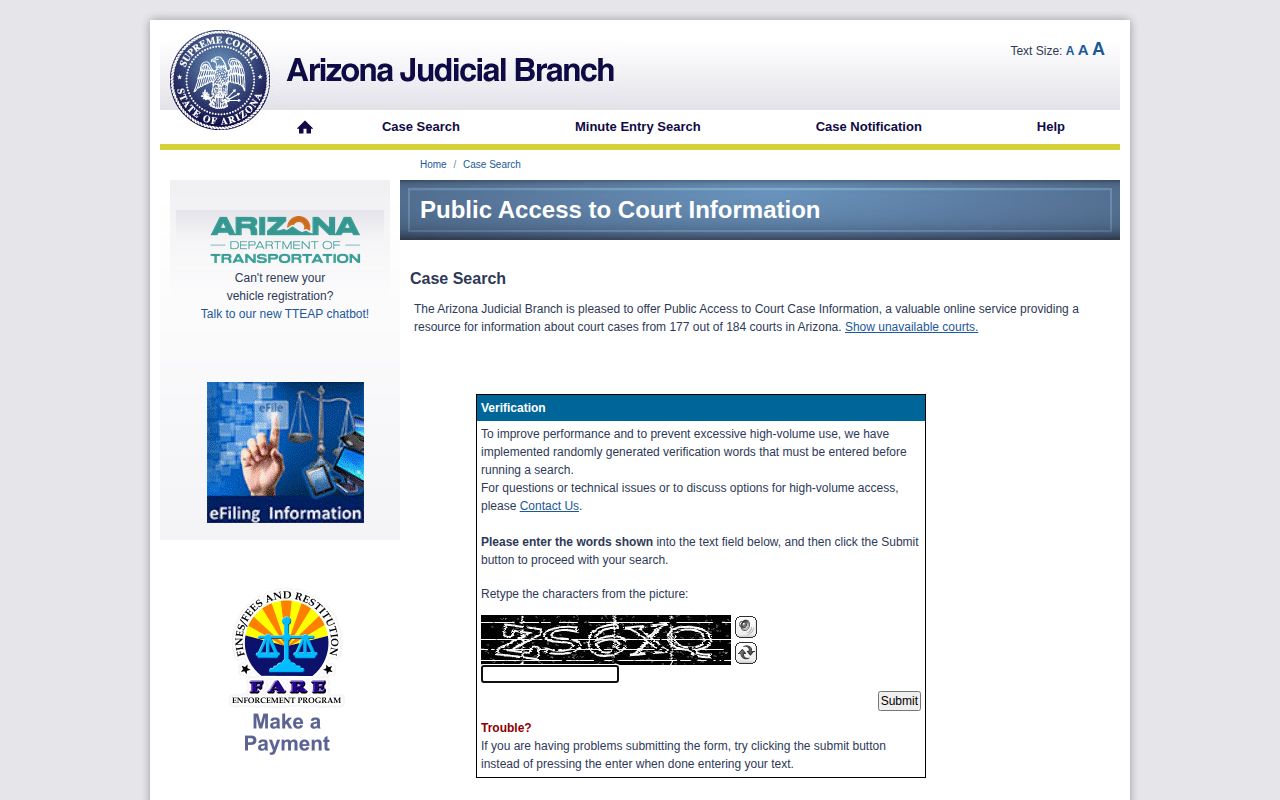
Use the page to find a possible case. Then confirm the warrant's current status with the court that holds it.
Arizona Court Documents
Need an actual court filing? eAccess is the separate route for eligible Superior Court case documents. Filings from July 1, 2010 forward are included. Pima County criminal documents generally begin July 1, 2015. You pay per document or by subscription. Sealed and confidential papers stay off the service entirely. A case-search result and a court document answer different questions. A filing can help someone review what a court received. It will not confirm a live warrant the way the issuing court can. Some documents are simply unavailable because of their date, court, or protected status. A search result may conflict with a notice or a newer court action. Ask the clerk which record controls. Arizona Courts explains eAccess coverage, date limits, and document fees.
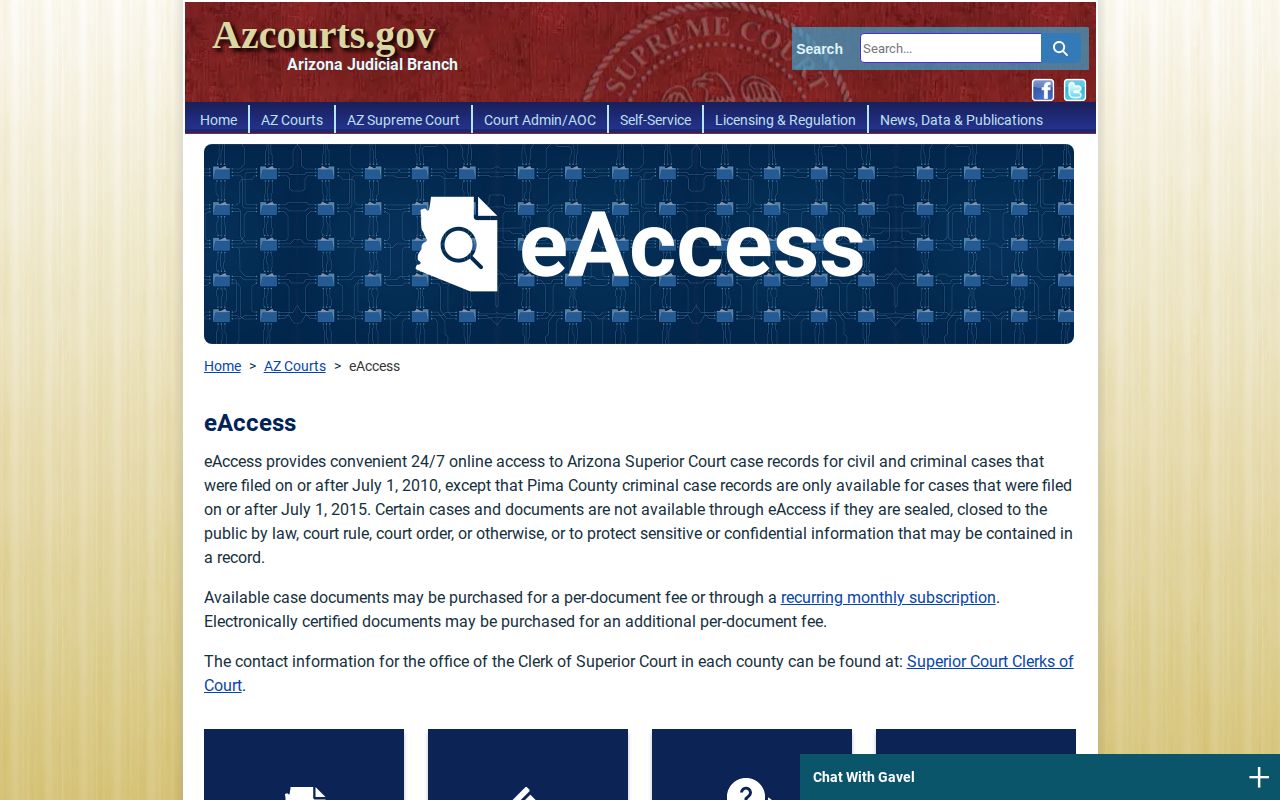
The eAccess screen lists selected filings, not active warrant status.
Note: A warrant search, case lookup, court filing, jail roster, and disposition are distinct records and may update on different schedules.
Arizona ADCRR Absconder Status
The state corrections system is its own world. The Arizona Department of Corrections, Rehabilitation & Reentry runs a corrections search. It is not a county jail roster. Results cover state custody and supervision. An "Absconder" entry marks a supervision status, nothing more. ADCRR Department Order 1003 defines the term and the department's warrant processes. ADCRR's Community Reentry page highlights an Absconder Reduction Program pilot in Maricopa County. One county pilot is not a statewide public list. Policy status, custody, and any criminal court case sit on separate tracks. The ADCRR inmate-data page displays status cautions and agency guidance rather than an individual profile. ADCRR explains its inmate-data search and notes that release details can change.
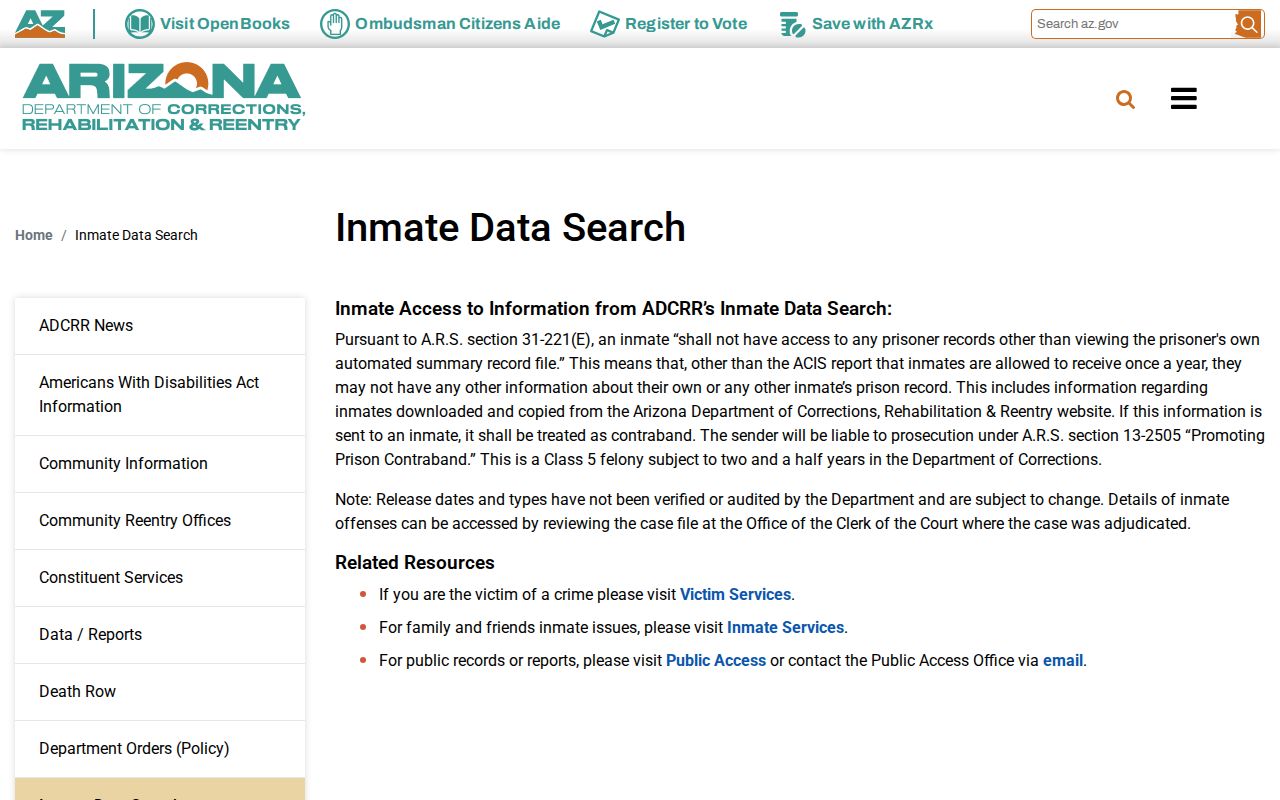
Need a county booking photo? Go back to the arresting or booking agency, since an ADCRR profile comes from the state corrections system.
Arizona County Warrant Routes
Warrant answers start close to home. A local court or agency often holds the record, so the statewide DPS search is not the only source. A custody page is not a warrant list. Apache County shows one local approach. Its official CitizenRIMS portal runs a warrant module alongside the current-custody search. That module stays local. It builds no statewide index and no fugitive list. When a question points to a county court or sheriff, follow that county's own instructions and confirm active status with the issuing court. A missing online tool does not mean the court holds no record. Arizona's County Directory can identify the right county agency. Verify the page is an official county source. A county booking search tells you where someone is held, not whether a separate warrant is still active. Apache County's warrant module illustrates one path, and it should never be used to check another county's warrant.
USMS Arizona Tip Line
The U.S. Marshals Service District of Arizona keeps a 24-hour tip line for federal fugitives. The number is 1-888-869-4589. Task forces operate in Phoenix, Tucson, Flagstaff, and Yuma. The national Profiled Fugitives pages feature selected cases only. They are not a complete list of Arizona warrants, county arrests, or people in custody. Share what you know and let trained officers assess it. Never post a suspected location, send a photo to an unofficial page, or try to confirm an identity yourself. Local and state tips belong with the responsible agency. For an immediate emergency, call 911.
U.S. Marshals Service, District of Arizona
Tip line, staffed around the clock: 1-888-869-4589, handling tips for the federal fugitive channel the District of Arizona describes.
Note: The Marshals’ individual profiles are selective federal notices, not a substitute for a court’s live warrant status.
Arizona Warrant Terms
These record words mark different steps. A warrant is a court process that authorizes an action. Confirm its type and current status with the issuing court. An "absconder" label comes from correctional supervision rules instead.
- Warrant
- A court-authorized process. DPS warns that its reported data may not show current status.
- Absconder
- An ADCRR supervision status defined by agency policy, not a stand-alone conviction.
- Disposition
- The court’s recorded outcome in a case. It must be checked with the court.
- Profiled fugitive
- A person featured in a selected USMS notice, not a complete public inventory.
A warrant can issue mid-case. The court may change its status later. An arrest or booking entry simply records that a person was taken into custody and processed. For anything that matters, verify the details with the responsible court or agency.