
Arizona Busted Mugshots by Record Layer
A booking photo gets taken at an arrest or a similar criminal-justice event. The jail builds its record during processing. That paper trail belongs to the county or city agency that made or received it. A jail is not a prison. Arizona's prison system keeps a separate profile for a person sentenced to state custody. Each office picks what goes public. An online page may show only part of the record.
Arizona has no single statewide mugshot database. A county roster lists people held right now. An arrest log may cover a short stretch or one police department. Released people drop off fast. Yet the booking record still sits in the agency file. A prison profile, a court docket, and a county booking entry each answer a different question. So layer the search to fit the question you are asking.
Read the record with care. Charges can shrink or vanish later. The booking image shows an event, not an ending. A court disposition records how the case actually closed.
- Booking
- The jail’s intake process after a person is brought into custody.
- Bond
- A court-set condition or amount that can allow release while a case is pending.
- Disposition
- The court’s recorded outcome for a case or charge.
- Sealing
- A court order that limits public access to an eligible record; it does not ensure that old copies vanish.
Arizona Busted Booking Record Fields
Arizona law spells out what counts as a criminal-justice record. A booking photograph, name, address, and physical description all fit. Criminal charges do too. The definition is not a promise of publication, though. A records unit may hold a fuller booking sheet than any roster shows. Later, a court case can add a filed charge. It can also add a disposition that the first jail entry never had.
| Record element | Where it may appear | What it can establish |
|---|---|---|
| Booking photograph | Agency file; public display depends on policy and law | An image taken for a justice-system event |
| Name and physical description | Statutory criminal-justice record; fields vary by portal | Identity details that should be matched with care |
| Booking number and date | Some county custody searches, including Yavapai and Yuma | A jail event identifier and date, not a case outcome |
| Housing or custody status | Current-custody searches such as Navajo and Yuma | Where a person is held at the time shown |
| Charges and bond | May appear in a county record; MCSO’s photo page has shown booking charges | The charge and a release condition, not a conviction |
| ADCRR number, status, location | State-prison profile | A state corrections record, separate from county booking |
| Case number and disposition | Court lookup or clerk record | The court’s case path and recorded result |
There is no standard form here. Arizona's counties run the range, from a bare name-and-location grid to a date-filtered inquiry or a document posted as a roster. Some show little. Others show plenty. Keep full birth dates, home addresses, victim details, and juvenile identifiers out of any public summary, and let the originating record point you to the official source for confirmation.
Arizona Busted Photo Requests
A.R.S. §39-121 opens records held by an Arizona public officer, subject to other laws and the public-records balancing test. The statute builds no photo search. It publishes nothing on its own. So aim requests at the agency that created or holds the record. Give enough detail to find an existing record. Then ask the custodian to explain any withholding or redaction in writing.
- Choose the custodian. For a county jail booking, start with the sheriff or the arresting police agency. For a state-prison profile or institutional image, use ADCRR Public Access.
- Describe the record. Give the person’s name, approximate event date, booking or case number if known, record type, and preferred delivery format. Ask for an existing record rather than a new statewide list.
- Check cost and timing. Arizona counties set their own request steps and may quote copying charges. The research found no statewide fixed response time.
- Use the state route for ADCRR. ADCRR accepts online requests for basic agency, employee, and inmate records. Its posted fees include $0.50 per hard-copy page, $0.10 per digital page, $15 per disc or drive, and $5 per five minutes of digital audio or video, capped at $15. No fixed turnaround is promised.
Costs and wait times vary by county. Yuma County describes an adult arrest record and booking photo without a form charge, with a 15 to 20 business-day wait. Mailed materials cost $1.50. Graham County prices things differently. A mugshot runs $5 there, a booking sheet another $5, and each booking-file sheet $0.25. None of these are statewide rates, so confirm current terms with the county before sending a request.
A released person drops off the roster. The agency still holds the booking record. A blank screen on a portal proves nothing, so go through the records office instead. The ADCRR public-record request page lays out the state agency's request path.
Arizona Busted Mugshot Law and Photo Access
Arizona's public-records statute, A.R.S. §39-121, opens records held by a public officer, subject to other laws and the balancing test. No county is forced to build a photo search. Booking images need not all go online. A separate law aims at commercial operators. Sections 44-7901 and 44-7902 regulate operators that use criminal-justice records to solicit paid business, including charging to remove or revise a record. That law, HB 2191, arrived in 2019. It exempts news dissemination and listed professional uses.
The statute orders no mass removal. In Houston v. County of Maricopa, the Ninth Circuit let a substantive-due-process claim proceed at the pleading stage. That ruling did not make every Arizona agency release unlawful. Cochise and Pima ended public booking-photo publication on their own, so county practice still varies.
Arizona Courts warns that records distributed before a sealing order may stay outside the court system. A set-aside under §13-905 is not erasure. §36-2862 is a narrow marijuana remedy. RecentlyBooked and Mugshots.com each describe a free way to request certain corrections or removals. Publisher terms are not court orders. The fuller legal paths sit in Public Mugshot Laws.
The official Arizona mugshot statute spells out the covered commercial conduct. Its exceptions are listed there.
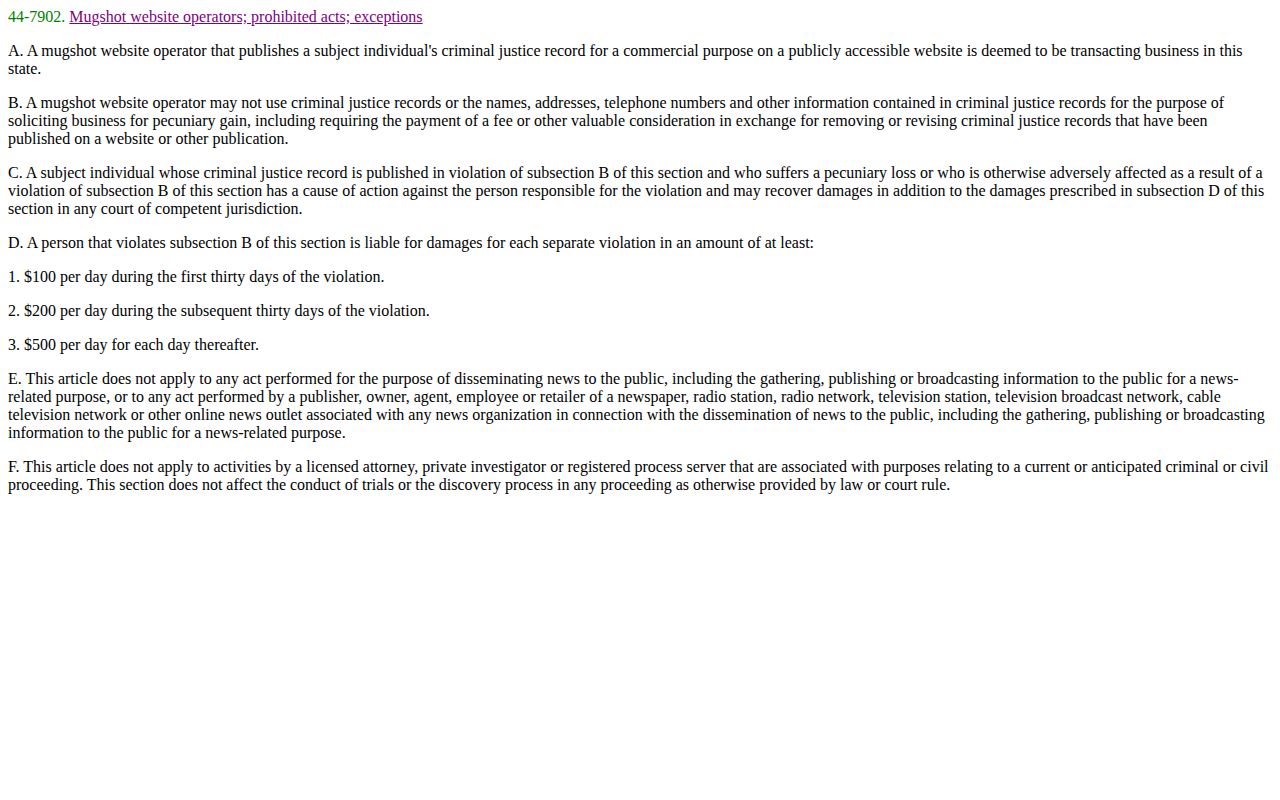
Arizona draws a line between what an agency must let the public see and how a publisher may use that material. Two different rules govern one photo. Access in any given case turns on who holds the record and whether a restriction applies.
Note: The 2024 federal appellate ruling addressed the allegations before the court and should not be restated as a statewide photo ban.
Arizona Busted Record Retention
Retention schedules tell an agency how long to keep a record series. They promise nothing about online availability. Expiration does not mean destruction either. Another schedule, an open case, or a legal hold can keep the material alive. Arizona's general schedule treats adult booking records, juvenile booking records, and other jail and detention files as separate series.
| Series | Research schedule description | Practical limit |
|---|---|---|
| GS-1031, item 20837 | Adult booking, jail, or detention records, which can include mugshot photos; ten years after last contact | Another schedule may govern when the record is part of a department report. |
| GS-1031, item 20838 | Juvenile booking and detention records; retention tied to age 18 | Juvenile access rules still apply while a record is retained. |
| GS-1031, item 20839 | Other booking, jail, or detention records; 30 days after last contact | Applies to the listed record types, not every booking file. |
Sealing, a set-aside, and expungement each do different work. A qualifying sealing order limits access to the covered records. It still cannot force a publisher or search engine to drop old copies. A set-aside leaves the police copy in place, and Proposition 207 expungement reaches only the marijuana conduct it lists. So read the order and the agency's reply before calling a photo removed.
Note: A retention period governs a record series; online display, archival transfer, and third-party copies remain separate questions.
Find Arizona Busted Mugshots
Every mugshot hunt starts with two questions. Where did the arrest happen, and which agency likely holds the person? Arizona runs its jails county by county. One search term will never reach every facility. For someone in current custody, check the official county source. The person may have been released, or the photo may not be posted. In that case, use the arresting agency's records route instead. A state prison inmate belongs in ADCRR. The filed case and its result live in court records.
- Identify the county or city agency tied to the arrest. If the county is unclear, use the Arizona County Directory to open the right local site.
- Use that county’s current-custody search or published booking log. Check the page’s date, search fields, and photo policy before treating a result as current.
- If the person is no longer in jail, request the booking record from the sheriff or arresting agency. A roster drop-off does not erase the record.
- If the person is serving a state sentence, check the official ADCRR profile and compare the displayed identifiers and status.
- For an outcome, use the court’s case lookup and confirm important details with the clerk. A roster or photo cannot supply a disposition.
A name alone rarely settles identity. Check the booking number or case number against the other details on screen. If they do not line up, stop. This path exists to locate the official record. It makes sense of a custody event. It is never a license to contact or confront someone listed in a public system.
Note: Arizona county portals are not synchronized, so a record can appear in one agency’s system before it reaches a court search or third-party copy.
Arizona Busted Photo Policies
Arizona's counties do not share one photo rule. MCSO's current custody interface has included a photo-capable page under county policy. Pima and Cochise stopped releasing booking photographs. That came after the 2024 litigation environment. Apache, Navajo, Mohave, and Yavapai list custody details without a routine public photo feed. La Paz says civilian mugshots are not released. A name-only roster can still answer a custody question without an image.
Maricopa and Pima show why photo access is a policy choice, not a statewide rule. The MCSO inmate-information page opens with booking-number or name-and-date-of-birth search fields rather than a gallery.
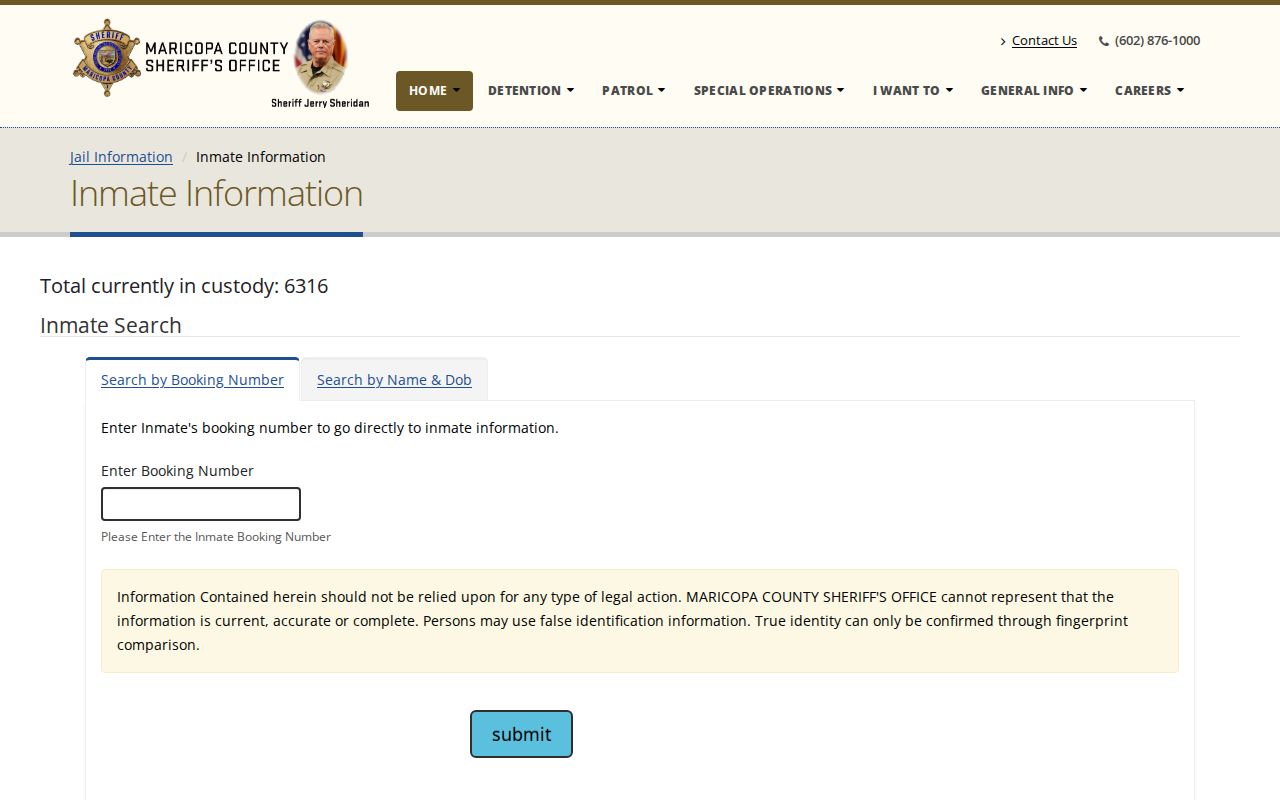
That screen tells you nothing about the next county. Pima's official lookup remains a custody search after the department ended booking-photo publication. The Pima County inmate lookup spells out its public view and search route.
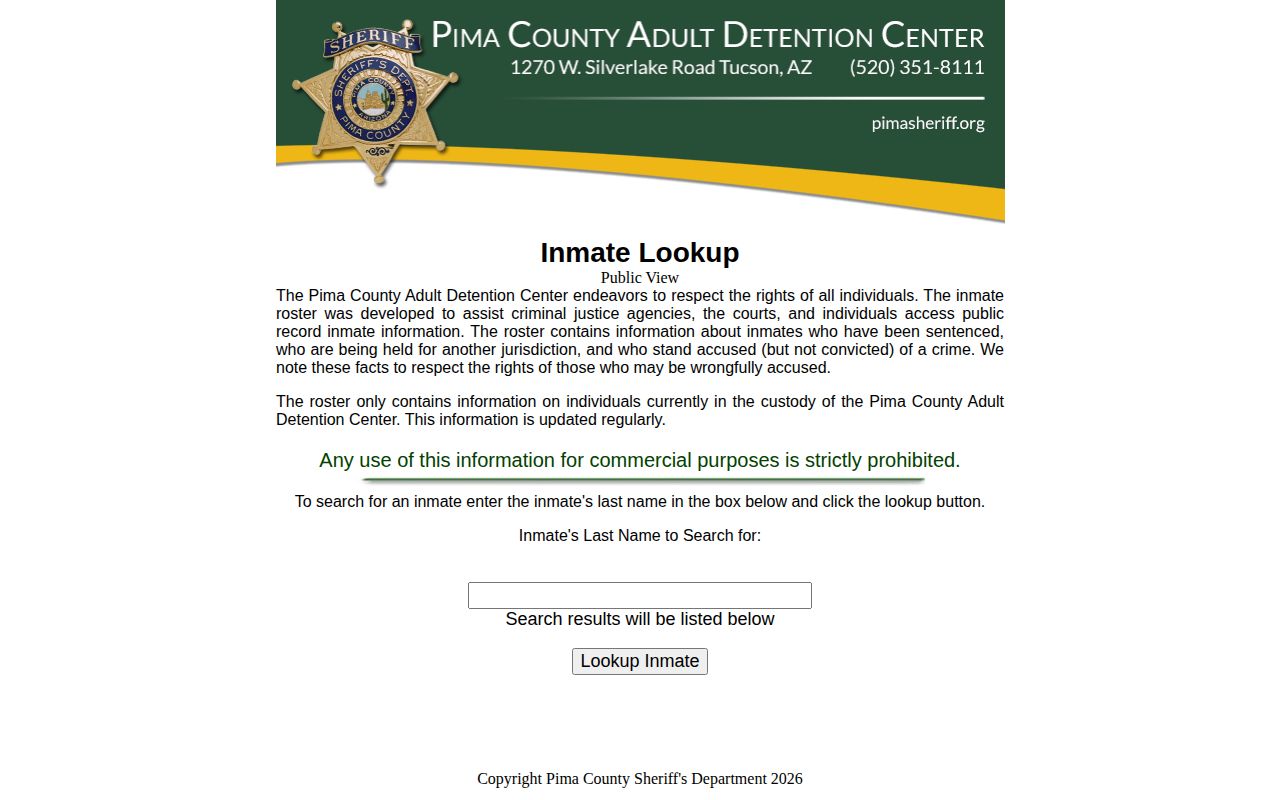
A county that stops posting photos may still hold the record. An agency can review a request for it. The court decision shifted the risk math; it did not enact a statewide ban on every release.
Arizona County Rosters and Feeds
The statewide roster landscape is a matrix of tools, not one feed. Some links show people in jail now. Others are older PDFs or paper logs. A current-custody grid is not the same as a same-day arrest feed. County pages change their notices over time. The live county site controls if its notice differs from any description here.
| County | Official access type found | Search fields or output | Photo and timing note |
|---|---|---|---|
| Apache | CitizenRIMS custody search | Current custody search | No public photo feed was visible; alerts and arrest-log modules were unavailable. |
| Cochise | Detention Division information | Direct agency route | Public web inmate list and photo page ended in September 2024. |
| Coconino | Flagstaff Jail or Page Jail contact and records request | Phone or request route | No public searchable roster or recurring photo feed was found. |
| Gila | Facility inquiry and sheriff records request center | Phone and records request | No current public web roster; visitation vendor is not a booking database. |
| Graham | Booking Roster PDF | Document output | Photo field and update cadence were not guaranteed. |
| Greenlee | Monthly jail-log archive | Text tables | Newest visible link in the sweep was older than the snapshot. |
| La Paz | Inmates & Arrests page and official sheriff app | Page and app status | Page said “Coming Soon”; the sheriff says civilian mugshots are not released. |
| Maricopa | MCSO current-custody search and separate photo page | Booking number, or name and date of birth | Photo policy and interface should be rechecked live. |
| Mohave | Timestamped inmate-list PDFs through press releases | Name-only files | No reliable photo, bond, charge, or booking-date fields. |
| Navajo | Live inmate-housing grid | Booking number, name, date of birth, location | No routine photo, charge, bond, or recent-bookings feed. |
| Pima | Last-name current-custody search | Last name | Booking photos stopped in September 2024; roster is not a released-person archive. |
| Pinal | Hourly-updated inmate search | Surname and inmate ID | Separate mugshot search was offline in the sweep. |
| Santa Cruz | Detention contact and focused record request | Direct agency route | No working public roster, photo feed, or search interface was identified. |
| Yavapai | Current-custody search | Inmate number, booking date, location, name | No photos or detailed recent-bookings feed in the sweep. |
| Yuma | Tyler/New World inmate inquiry | Name, subject and booking numbers, custody status, booking dates, housing | Images may appear, but are not guaranteed; updates are periodic. |
There is no uniform statewide booking window. A county that posts a log may update it at its own pace, and the roll-up did not confirm a shared same-day, 48-hour, or weekly standard. Weekend activity can be absent from a short log and later appear in a custody search. The local county site is the route for current details and its specific records office.
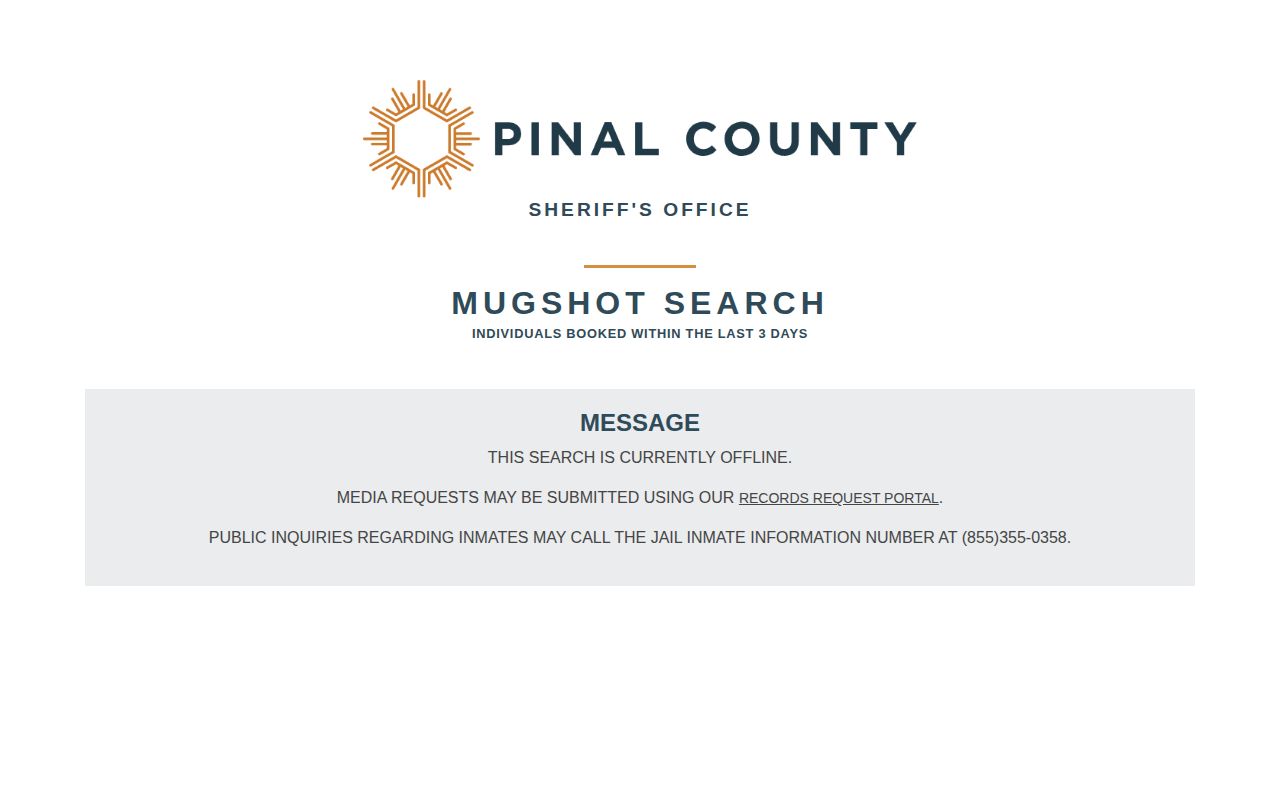
Pinal’s separate photo page gave an example of an endpoint that may not be available when a reader checks it.
Pinal County’s mugshot-search page displayed an offline notice during the research sweep.
La Paz sits in a different spot. Its sheriff states that civilian booking photos are not released, and the inmate-and-arrests page is not yet live. La Paz County Inmates & Arrests carries a "Coming Soon" notice.
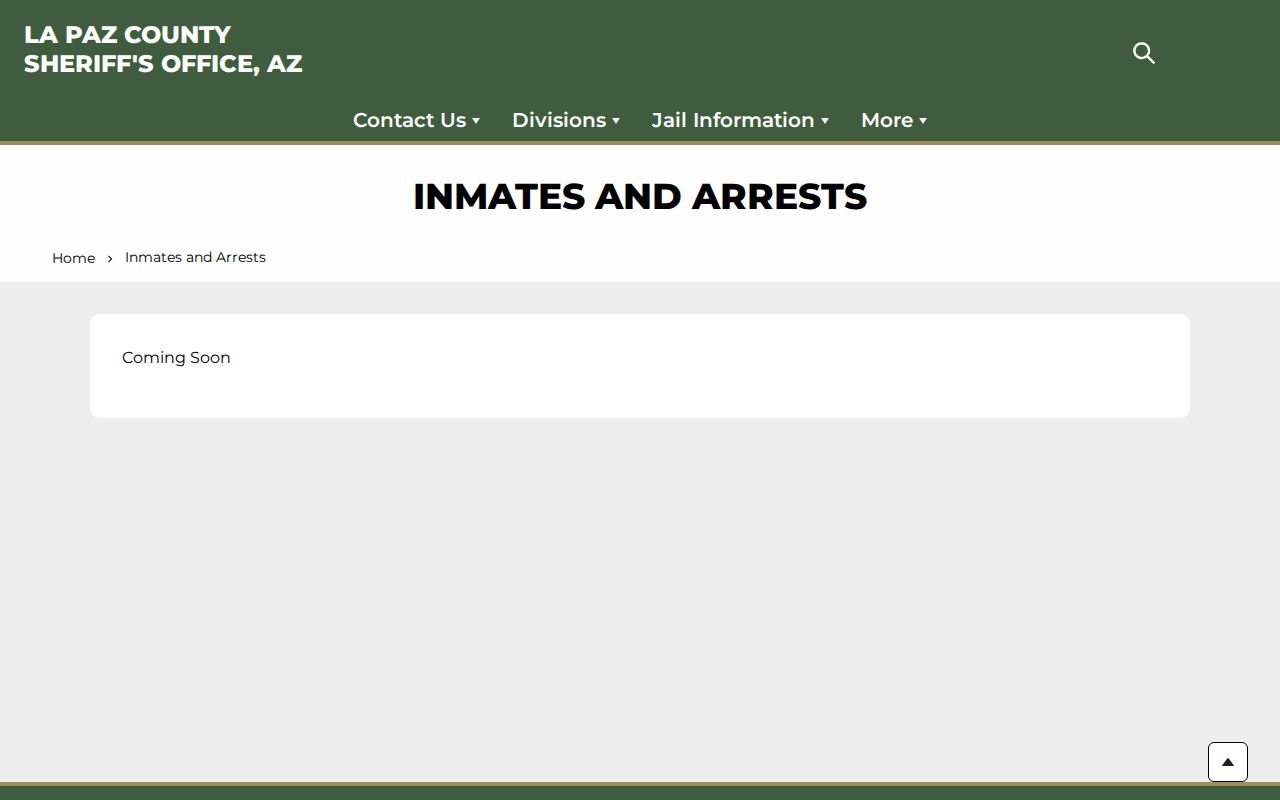
"Coming Soon" is not a promise that photos will follow. The sheriff's stated publication policy is what governs photo access there.
Arizona Busted Booking Event Counts
Yuma County counted 5,249 bookings and 5,227 releases in 2025. Those are events, not people. The same person can be booked more than once. And a release count says nothing about whether a charge was dismissed or a case went forward, so read the numbers as booking activity only.
The distinction matters when a news story or data page labels its entries "recent arrests." A pile of records is not a pile of people. Before comparing years or counties, use the date and definition the issuing agency supplies. Arizona publishes no single state total. No state figure converts local booking counts into a statewide rate. Any rate you see came from someone's own math.
Note: Yuma’s 2025 figures describe booking and release events, so they should not be read as a count of convictions or distinct individuals.
Arizona Booking and Mugshot Sources
Start with the official systems. A county sheriff or police page will show whatever custody data that agency publishes, and a records unit can tell you whether an older booking sheet or photo still exists. State-prison profiles live with ADCRR. Arizona's courts add a separate case layer on top. Federal prison and immigration custody run through their own federal locators, so check those systems directly. Each source covers a different slice, and a blank result in one of them is never the whole answer.
| Source | What it can show | Limit |
|---|---|---|
| County custody search | People held now and selected booking fields | May omit released people and photos |
| County arrest log or PDF | Selected arrests or a dated group of bookings | May be delayed, partial, or lack photos |
| Agency records request | Existing booking record or photo held by the agency | Access, fees, and timing depend on the custodian |
| Arizona court search | Participating court case entries | Not the official record; sealed and other cases are excluded |
| ADCRR search | State corrections profile and a photo where shown | Not a county booking or court disposition |
| News report | Selected event coverage and context | Not a full booking list; follow the court result |
| Third-party publisher | A copy or index collected from other sources | Unofficial, incomplete, possibly stale or misidentified |
Third-party sites cover Arizona unevenly. RecentlyBooked's state page lists only part of the counties. Its publisher policy allows free updates or removal for grounds like a wrong person, a dismissal, sealing, or an outdated entry. Supporting material may be requested. Mugshots.com likewise describes a free record-maintenance process. It asks for proof and a page identifier. Treat both as publisher policies, not court orders, and no promise that every copy vanishes.
Busted Newspaper's Arizona routes shift often. Arrests.org's state material covers only some counties, and Mugshots.zone lists no Arizona section. Any copy there is secondary. Never assume a listing is current or complete. And skip any paid service claiming it can erase a public record. The agency, court, or publisher's own published process is the right route.
Arizona Busted Warrant and Fugitive Records
The Arizona DPS Warrant Search pulls information from the courts. DPS itself warns that the data is not real-time, current, or complete. A similar name can return a false match. Confirming whether a warrant stays active belongs to the issuing court. Arizona DPS's WANTED Task Force pairs federal, state, and local agencies on fugitive work. The state posts no single public photo list for every warrant. ADCRR's "absconder" label concerns supervision. U.S. Marshals profiles cover only selected federal fugitive cases.
Never approach, follow, or detain anyone on a list. Someone worried about a possible warrant has options. Call the issuing court or a lawyer. The separate Fugitive List guide lays out the safe check path.
Arizona Busted DOC Offender Photos
ADCRR stands for the Arizona Department of Corrections, Rehabilitation & Reentry. Its inmate data search takes a name or an ADCRR number. It returns state corrections profiles. The system tracks state custody and supervision, not fresh county bookings. A prison profile can stay visible after a person leaves active custody. The displayed status and release details can shift. ADCRR states plainly that release dates and release types are unverified and subject to change. Any photo shown is an institutional corrections image. It is not necessarily the county booking photo from the arrest that led to the sentence. Match the ADCRR number and other identifiers. Then turn to the court clerk for the case result. The official ADCRR inmate-data page links to the search and explains the status limits.
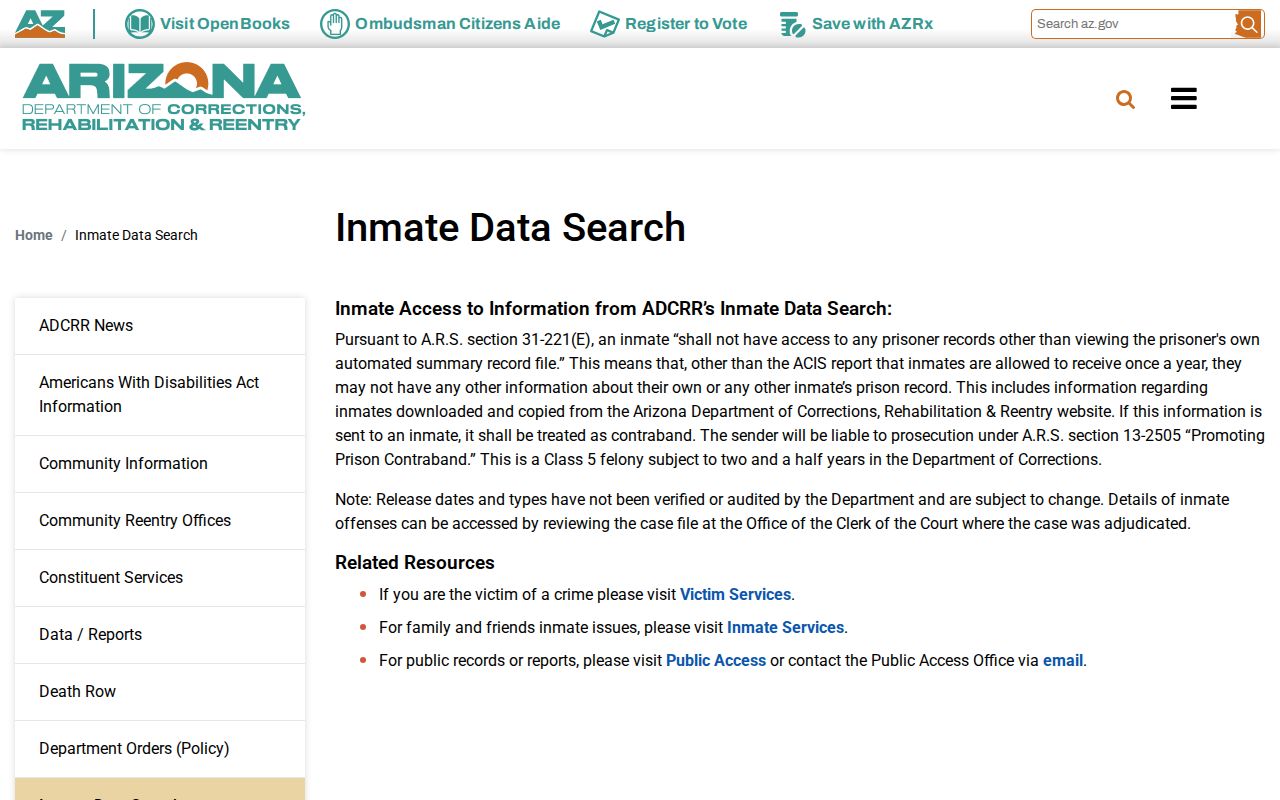
The agency also takes inmate-record requests through its Public Access office. Check its current request terms before ordering copies, since fees and response times can change.
Arizona Busted Court Records and Dispositions
Arizona Public Access Case Lookup reaches only participating courts, not every court or every case. It lists coverage of 177 of 184 courts. The system refreshes weekly on Friday, with data through Wednesday. It states that it is not the official court record. Sealed matters, juvenile cases, and mental-health matters are excluded or limited. So are probate, protective orders, and other confidential categories. An entry can help you locate a clerk and confirm a matter exists. It is not a booking-photo source. It does not replace the case file. For a disposition, use the issuing court's record or clerk. A charge can change after booking, and a jail release does not mean dismissal. The Arizona Public Access Case Lookup displays its coverage and notice before any search.
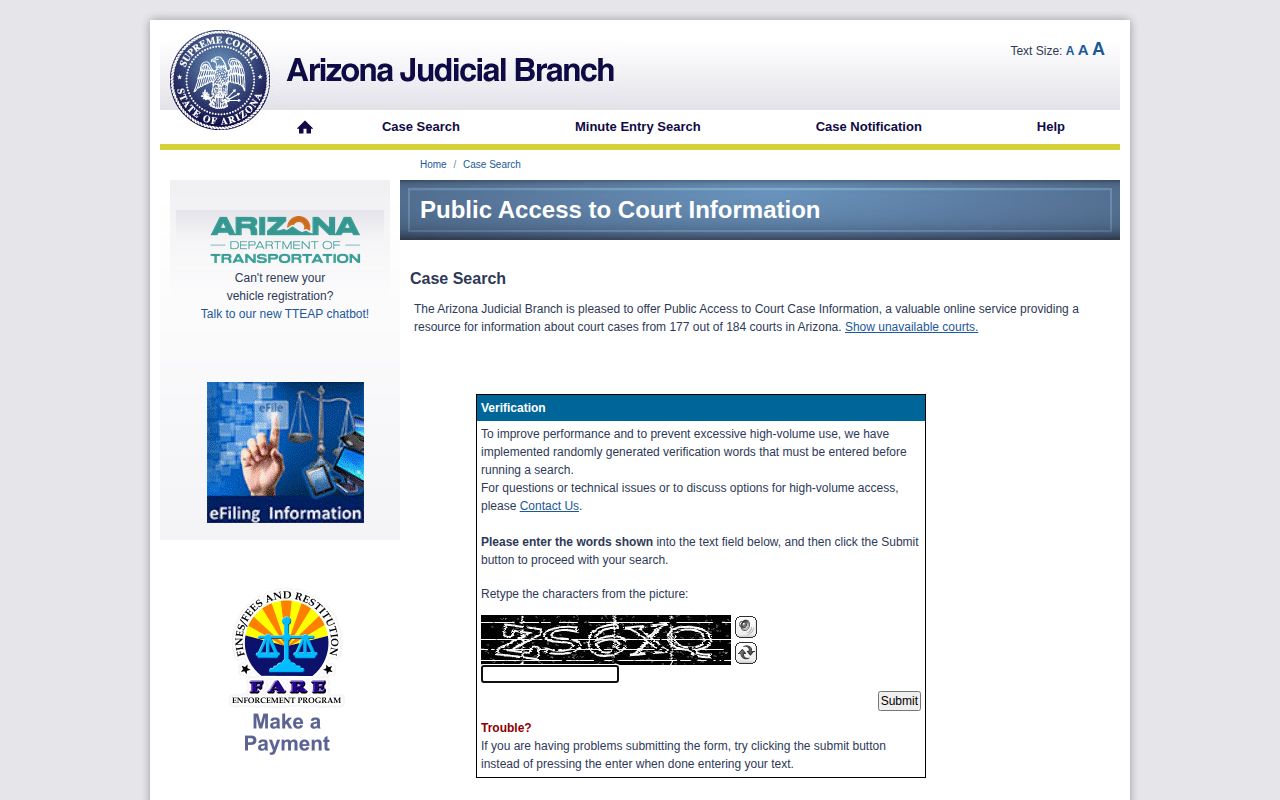
Where a court document qualifies for online access, Arizona eAccess applies its own date limits, fees, and sealed-record exclusions. A docket result and a purchased document are different records.
Arizona Busted Custody Alerts
Arizona's Criminal Justice Commission keeps a dated inventory of victim-notification tools. County participation in VINE and related services varies. VINE sends custody-status alerts; it is no mugshot archive, arrest feed, or court-disposition system. A notice tells an enrolled user that custody changed, nothing more. County sheriff apps differ too. La Paz has an official sheriff app. Navajo's app works as a public-safety and tips tool. Pima has an official department app, but the county ended booking-photo publication. The app is no photo feed. Most Arizona counties publish no jail-photo app at all. Check the official county page for its current feature list before leaning on a notification.
Note: A custody alert tracks a change in status, while a court docket tracks the case and a county record request reaches the agency file.
Arizona Busted Records When Portals Fail
When a search page goes down, the record usually still exists. Pinal keeps a separate mugshot search. But its page has shown an offline notice. The notice pointed visitors toward records requests instead. La Paz has labeled its inmate-and-arrests page “Coming Soon,” with no booking photos for the public there. In situations like these, the fallback is the county's own records unit. Try the detention contact too. Skip the third-party site that may have copied an old entry.
Some counties offer a portal only for people in custody right now. Others post a static PDF or a monthly log. Ask the custodian for the exact event, date range, booking record, or photo. Let them say what exists and what can be released. A missing portal field does not mean nothing was recorded. And never ask a clerk to certify details from a private copy.
Arizona Federal and ICE Locators
The BOP inmate locator reaches federal inmates back to 1982 and gets daily updates. It shows no booking photos. Older federal records live at the National Archives. Even a BOP records request can hit privacy, law-enforcement, safety, or other exemptions.
That tool is separate from the ICE Online Detainee Locator. The ICE search covers people currently detained by ICE. It also reaches people released within its stated lookback window. You need the exact A-number plus country of birth. Otherwise give the name, country of birth, and date of birth. It excludes anyone under 18 and has no photo field at all. Someone missing from the results may simply be held elsewhere. Or the person falls outside the locator's limits.
Keep federal prison, immigration detention, state prison, and county jail custody separate in your mind. A hit in one locator proves nothing about another system. For an immigration custody question, use ICE's official contact route. Do not read meaning into an empty result.
Arizona News and Aggregator Copies
Arizona newsrooms cover selected events, never every arrest. A story might run a photo supplied by police or a sheriff, but that image belongs to one story at one point in time. Arizona’s commercial mugshot statute includes a news exception. Still, news coverage is not a custody list. Trace the story to the court record for a disposition, and back to the agency for a current custody check.
Aggregator pages collect and republish booking material from agencies. Their Arizona coverage runs uneven, and copied entries can lag behind the source. A missing page proves nothing about whether an arrest happened. RecentlyBooked and Mugshots.com each publish free correction or removal criteria, yet those private rules bind neither an Arizona court nor every other publisher. Anyone seeking a change should work from the exact publisher page and supply a court order or other supporting record when asked. No payment guarantees that every copy disappears.
Arizona Busted or Released Records
Match the search to the person’s custody stage. A fresh county booking often surfaces first in the arresting agency’s log or a jail’s intake system. Someone still housed may sit in a current-custody roster. After release, the roster can drop the entry while the booking sheet stays on file with the agency. A state prison sentence moves the search to ADCRR. The court docket carries the case and its disposition.
| Status or record | Best first source | What it does not answer |
|---|---|---|
| New arrest or booking | Arresting agency log or county booking source | Whether charges will be filed or proven |
| Currently in county custody | County jail custody search | Why the case ended or whether a photo is public |
| Released from county jail | Agency booking-record request | Current location or final court outcome |
| State-prison profile | ADCRR Inmate Data Search | Whether the person is currently in county jail |
| Case result | Arizona court lookup and the court clerk | Whether someone is in custody now |
Does a release mean a case was dismissed? No. Release only means that person left that custody event. The case may still be pending, resolved later, or handled in another court. Check the docket or clerk for the disposition.
Use the record that fits the question. A current roster answers current jail custody. A booking record documents an earlier event. A court disposition gives the procedural result, and an ADCRR profile concerns state corrections. One database cannot safely stand in for all four.
Arizona Busted Mugshots by County
Every Arizona county runs its own path, fields, and photo policy. Big urban systems are not always more open. Maricopa offers a developed current-custody interface. Pima and Cochise ended public photo release. Smaller counties may rely on a phone inquiry, an older log, or a request form. County lines do not define every arrest or court. Follow the agency named in the event record whenever you know it.
The county directory routes to Apache, Cochise, Coconino, Gila, Graham, Greenlee, La Paz, Maricopa, Mohave, Navajo, Pima, Pinal, Santa Cruz, Yavapai, and Yuma County sites. Those local pages hold the finer county and city search details. Start with the county that booked the person. Then follow the named agency if the arrest happened inside a city.
Older Arizona Busted Photo Archives
Chasing an old booking photo? Begin with the office that made it. That could be the sheriff, a city police department, a county jail, or ADCRR. Arizona's retention schedule splits adult booking files from juvenile and other detention record series. Each series carries its own clock. Also note that a retention period guarantees nothing online. A file can sit in storage for decades without ever appearing on a portal. Historic state holdings and modern county intake records remain two very different collections.
The Arizona State Archives keeps permanent state records, manuscripts, and photographs. Its research pages point to finding aids and the Arizona Memory Project. That project holds historic Territorial Prison material. Treat these as leads toward documented collections. This is not a general hunt for every old Arizona mugshot.
Once a record has aged out of a jail portal, a focused records request is still the first step. The separate Mugshot Archives guide walks through retention rules and historic collections.